Return to MSU Cares Home Page

Aflatoxin Accumulation in Commercial Corn Hybrids in 1998

Gary L. Windham and W. Paul Williams

Windham is a research plant pathologist, and Williams is a research geneticist with the USDA-ARS Crop Science Research Laboratory at Mississippi State University. The authors thank E. Lee Scruggs, Paul Buckley, and Gerald A. Matthews, Jr., for technical assistance.


Contents


Introduction

Aflatoxin is a naturally occurring toxin produced by the fungus Aspergillus flavus. This toxin is the most potent carcinogen found in nature (Castegnaro and McGregor 1998; Park and Liang 1993; Pittet 1998). In the United States, aflatoxin contamination of corn grain occurs sporadically in the Midwest, but it is a chronic problem in the Southeast (Payne 1992; Widstrom 1996). In 1998, a major aflatoxin epidemic in corn occurred in the Southeast. Higher than normal temperatures, drought conditions, insect damage, and other factors contributed to high levels of aflatoxin contamination in corn grain.

The U.S. Food and Drug Administration limits the sale of grain with aflatoxin levels exceeding 20 parts per billion (ppb) (Park and Liang, 1993). Grain exceeding 20 ppb cannot be shipped across state lines and can only be used for livestock feed. Once corn is found to be contaminated with aflatoxins, very few detoxification and utilization options are available.

The best strategy for aflatoxin control is to limit the amount of aflatoxin accumulating in the developing corn crop. Cultural control practices, such as using adapted varieties, irrigation, planting dates, and optimal fertilization, can minimize aflatoxin contamination most years (Jones et al. 1980, 1981; Larson 1997; Payne 1992). However, no control strategy is completely effective when environmental conditions are extremely favorable for growth of the fungus.

The most desirable method of aflatoxin control is through host plant resistance to A. flavus infection and subsequent aflatoxin accumulation. Unfortunately, no commercial hybrids have been identified that are resistant to A. flavus. Additionally, only limited information is available on the reaction of commercial hybrids to A. flavus under field conditions. The objective of this study was to evaluate commercially available corn hybrids for aflatoxin accumulation when developing ears were artificially inoculated with A. flavus in the field.


Materials and Methods

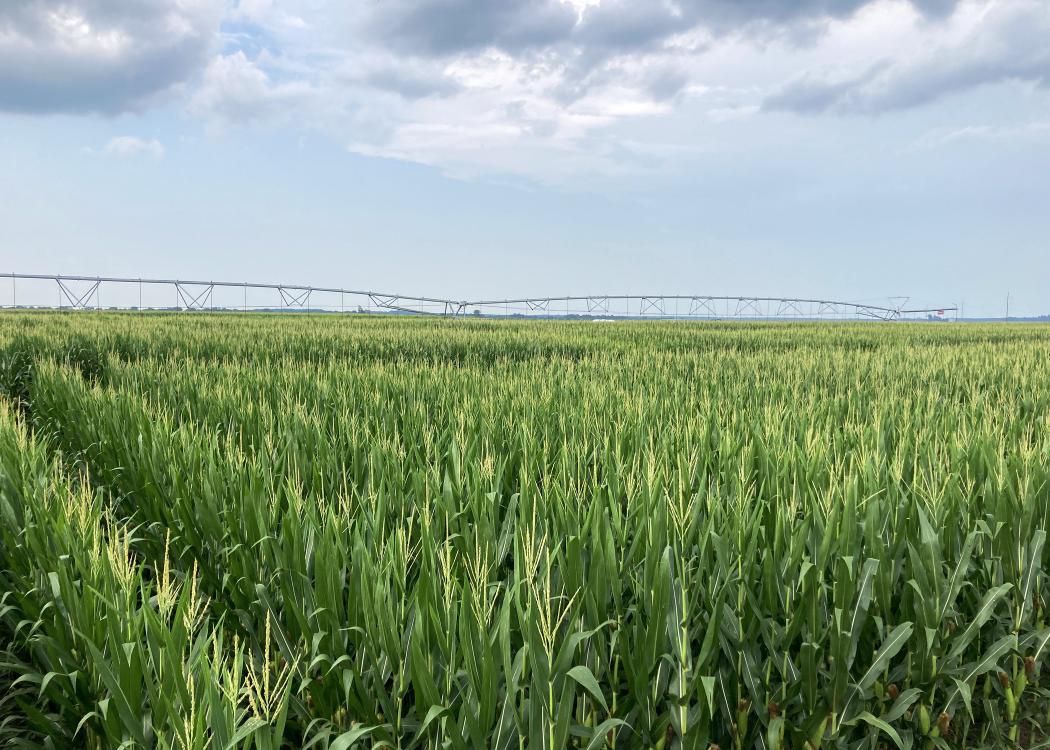
Forty-five commercial corn hybrids included in the 1997 Mississippi Agricultural and Forestry Experiment Station Variety Trials were used in our studies. Also included were four hybrids from our research program used as resistant checks. These hybrids were grown at Mississippi State University's Plant Science Research Farm in two separate tests. The only differences in the two tests were the methods used to inoculate the corn ears with A. flavus. Hybrids were grown in a randomized complete bloc k design with five replications. Hybrids were planted May 4, 1998, in single-row, 5.1-meter plots spaced 0.96 meter apart. Plants were thinned to 20 plants per plot. Plots received supplemental irrigation during the growing season to limit drought stress.

A. flavus isolate NRRL 3357, which is known to produce aflatoxin in corn grain (Scott and Zummo 1988), was used as inoculum in both tests. Inoculum was increased on sterile corn cob grits in 500-milliliter flasks, each containing 50 grams of grits and 100 milliliters of water, and incubated at 28 °C. Conidia were washed from the grits using sterile distilled water containing 20 drops of Tween 20 per liter and filtered through four layers of sterile cheesecloth. The concentration of conidia was determined with a hemacytometer and adjusted with sterile distilled water to 90 billion per milliliter. Inoculum not immediately used was refrigerated at 4 °C. In Test 1, hybrids were inoculated 7 days after midsilk (50% of the plants in a plot had silks emerged) using the side needle technique (Zummo and Scott 1989). The top ear of each plant was inoculated with a 3.4-milliliter suspension containing 300 billion A. flavus conidia. In Test 2, hybrids were inoculated using a Solo backpack sprayer (Solo, Newport News, VA). Hybrids were sprayed weekly for 5 weeks beginning when silks emerged from the ears. A spore suspension containing 300 billion A. flavus conidia and a spreader sticker (Hi-Yield Chemical Co., Bonham, Texas) were applied to the silks and husks on the top ears of each plant.

Ears were hand harvested around 63 days after midsilk and dried at 38 °C for 7 days. Ears were then machine shelled, and grain samples from each row were poured into a sample splitter twice to mix the grain. Samples were ground using a Romer mill ( Union, Missouri). Aflatoxin contamination in 50-gram subsamples from each plot was determined using the Vicam Aflatest (Watertown, Massachusetts). This procedure can detect aflatoxins (B1, B2, G1, G2) at concentrations as low as 1 ppb.

Data were subjected to analysis of variance. Means were compared by the least significant difference test (LSD) at P = 0.10.


Results and Discussion

Aflatoxin levels were extremely high in 1998. In Test 1, aflatoxin levels ranged from 70 ppb to 11,936 ppb for Mp313E x Mp494 and Terral TV2100, respectively. The lowest level of aflatoxin contamination of a commercial hybrid was in Funk's DG 5510A (52 9 ppb). Three resistant hybrids that had Mp313E as one of the parents had the lowest levels of aflatoxin contamination (70 ppb to 264 ppb).

In Test 2, aflatoxin levels ranged from 102 ppb to 8,100 ppb for Mo18w x Mp313E and Terral TV2100, respectively. The lowest level of aflatoxin contamination of a commercial hybrid was in Funk's 5688 (910 ppb). When aflatoxin levels for individual hybrids were combined and averaged for Test 1 and Test 2, the lowest level of aflatoxin contamination was in AgraTech 1177 (890 ppb).

The two inoculation methods yielded similar results. When averaged across hybrids, aflatoxin contamination in hybrids inoculated using the side-needle technique and the spray inoculation technique was 3,603 ppb and 3,234 ppb, respectively. Aspergillus spores are injected under the husks using the side-needle technique. The spraying inoculation technique more closely simulates natural infection. Spores are applied to the exterior of developing ears on the silks and husk tissue. Also, spraying spores using a backpack sprayer is much less labor intensive compared with the side-needle technique. If the spraying technique can yield consistent results, it would be much easier to conduct large-scale inoculations than using the side-needle inoculation technique.

Two commercial hybrids (Novartis N7590Bt and N7639Bt) with the Bacillus thuringiensis (Bt) toxin were included in the studies. Ear tissues of both hybrids contain the Bt toxin. Because insect damage is often associated with aflatoxin contamination of corn, it has been suggested that the grain of Bt hybrids may have lower levels of aflatoxin contamination when compared with non-Bt hybrids. However, the Bt hybrids did not perform any better than the other commercial hybrids. Aflatoxin contamination for N7639Bt and N7590Bt, when averaged across both tests, was 2,652 ppb and 3,976 ppb, respectively. There are several reasons why Bt hybrids are not effective in eliminating aflatoxin in corn grain. Although insect damage has been associated with high levels of aflatoxin contamination, A. flavus can infect developing corn kernels and produce aflatoxin in the absence of ear-damaging insects. Also, insect larvae must feed on the corn tissue to ingest the Bt toxin. Even a minimal amount of feeding by insects would provide entry sites for A. flavus to colonize the damaged kernels.

All of the commercial hybrids had high levels of aflatoxin accumulation, regardless of inoculation method. Aflatoxin levels for all hybrids greatly exceeded the FDA threshold level (20 ppb) for aflatoxin in corn grain. Although some hybrids had lower levels than others, because of the variability of the data and the high LSD's, it is very difficult to determine if one group of hybrids is superior to another group of hybrids. Also, under different environmental conditions, rankings for individual hybrids may change after further evaluations.

The results of our tests demonstrate the need for the development of aflatoxin-resistant corn. The USDA-ARS Corn Host Resistance Research Unit (CHRRU) released the first corn germplasm (Mp313E and Mp420) with resistance to A. flavus (Scott and Zummo 1990, 1992). Several of the hybrids with Mp313E as a parent had the least amount of aflatoxin contamination, regardless of inoculation method. Mp420 has been equally effective in reducing aflatoxin contamination in other studies (Scott and Zummo 1988 ; Windham and Williams 1998). CHRRU scientists are conducting field and lab studies to identify and locate the genes associated with aflatoxin resistance. Once this has been accomplished, it will be feasible for commercial seed companies to transfer the genes responsible for aflatoxin resistance into their elite material. Commercial corn hybrids could be made available to growers in regions where aflatoxin contamination is a chronic problem.


References

Castegnaro, M., and D. McGregor. 1998. Carcinogenic risk assessment of mycotoxins. Revue Med. Vet. 149:671-678.

Jones, R.K., H.E. Duncan, and P.B. Hamilton. 1981. Planting date, harvest date, and irrigation effects on infection and aflatoxin production by Aspergillus flavus in field corn. Phytopathology 71:810-816.

Jones, R.K., H.E. Duncan, G.A. Payne, and K.J. Leonard. 1980. Factors influencing infection by Aspergillus flavus in silk-inoculated corn. Plant Dis. 64:859-863.

Larson, E. 1997. Minimizing aflatoxin in corn. Miss. Coop. Ext. Ser. Information Sheet 1563.

Park, D. L., and B. Liang. 1993. Perspectives on aflatoxin control for human food and animal feed. Trends in Food Sci. & Technol. 4:334-342.

Payne, G.A. 1992. Aflatoxins in maize. Critical Rev. in Plant Sci. 10:423-440.

Pittet, A. 1998. Natural occurrence of mycotoxins in foods and feeds - an updated review. Revue Med. Vet. 149:479-492.

Scott, G.E., and N. Zummo. 1988. Sources of resistance in maize to kernel infection by Aspergillus flavus in the field. Crop Sci. 28:504-507.

Scott, G.E., and N. Zummo. 1990. Registration of Mp313E parental line of maize. Crop Sci. 30:1378.

Scott, G.E., and N. Zummo. 1992. Registration of Mp420 germplasm line of maize. Crop Sci. 32:1296.

Widstrom, N.W. 1996. The aflatoxin problem with corn grain. Advances in Agronomy 56:219-280.

Windham, G.L., and W.P. Williams. 1998. Aspergillus flavus infection and aflatoxin accumulation in resistant and susceptible maize hybrids. Plant Dis. 82:281-284.

Zummo, N., and G.E. Scott. 1989. Evaluation of field inoculation techniques for screening maize genotypes against kernel infection by Aspergillus flavus in Mississippi. Plant Dis. 73:313-316.


Table 1. Aflatoxin contamination in commercial corn hybrids inoculated with Aspergillus flavus using two inoculation methods.

Hybrid
number

Brand
name

Aflatoxin (ppb)

Test 11

Text 22

Mean

Mp313E x Mp4943

--

70

149

110

Mo18w x Mp313E3

--

264

102

174

Mp420 x Tx6013

--

907

455

624

Mp313E x Mp4203

--

202

951

670

1177

AgraTech

688

1,092

890

5688

Funk's

1,540

910

1,190

5510A

Funk's DG

529

2,160

1,409

8460

Mycogen

1,792

1,232

1,512

TV2930

Terral

1,944

1,096

1,520

DK683

DeKalb

1,752

1,481

1,617

5670

Funk's DG

1,724

1,792

1,758

TR1167

Terra

2,025

1,840

1,922

RX897

Asgrow

2,540

1,489

1,956

HS9977

AgriPro

3,016

973

1,995

3223

Pioneer

2,256

1,772

2,014

HY9899

AgriPro

2,640

1,696

2,116

32K61

Pioneer

3,120

1,464

2,200

8328

Cargill

3,136

1,305

2,220

999

AgraTech

2,380

2,248

2,307

3085

Pioneer

3,256

1,416

2,336

TR1185

Terra

2,872

1,896

2,384

N7639 Bt

Novartis

2,256

3,048

2,652

TVX21370

Terral

2,888

2,432

2,660

ATX770

AgraTech

2,632

2,760

2,696

DK687

DeKalb

2,900

2,792

2,846

TR702

Terra

2,752

2,944

2,848

3394

Pioneer

3,688

2,192

2,940

HY9919V

AgriPro

2,584

3,504

3,044

TR1154

Terra

3,072

3,240

3,156

TR1226

Terra

2,656

4,168

3,412

HS9843

AgriPro

2,624

4,570

3,597

AP9707

AgriPro

3,936

3,440

3,688

3163

Pioneer

4,176

3,304

3,740

DK706

DeKalb

3,968

3,600

3,784

TR1157

Terra

4,168

3,496

3,832

RX938

Asgrow

5,104

2,672

3,888

N7590Bt

Novartis

4,856

3,096

3,976

3245

Pioneer

4,824

3,600

4,212

7770

Cargill

5,096

3,424

4,260

AP9909

AgriPro

6,320

2,448

4,384

DK626

DeKalb

6,424

2,672

4,548

HS9944

AgriPro

4,616

4,792

4,704

RX813

Asgrow

5,104

4,480

4,792

TMF 113

Mycogen

5,704

4,568

5,136

3260

Pioneer

6,440

4,720

5,580

TR1066

Terra

7,280

4,008

5,644

8011

Cargill

9,112

3,736

6,424

ATX721

AgraTech

10,792

6,640

8,716

TV2100

Terral

11,936

8,100

10,018

LSD (P = 0.10)

2,759

2,208

2,095

1Fungal spores were injected under the husk of each ear.
2Fungal spores were sprayed on the silks and husks.
3Resistant checks.


Mention of a trademark or proprietary product does not constitute a guarantee or warranty of the product by the Mississippi Agricultural and Forestry Experiment Station and does not imply its approval to the exclusion of other products that also may be suitable.

Mississippi State University does not discriminate on the basis of race, color, religion, national origin, sex, age, disability, or veteran status.

A black line that separates the body text from footer information