|
|
|||||||||||||||||||||||||||||
Agronomy NotesMay, 2004
Dr. Collins is now living in Starkville, MS, with his wife Linda, son David, and daughter Elizabeth lives in Virginia. Dr. Collins can be reached at (662) 325-2311 or by email at mcollins@pss.msstate.edu.
Soil
and Nutrient Management The 2002 Farm Bill offered many ways for producers to demonstrate their commitment to preserving the resource base. In the discussion prior to the passage and signing of the bill, the Office of Management and Budget asked for better accounting of the costs/benefit of conservation programs. The Conservation Effect Assessment Program, or CEAP, is working to provide that information, ultimately the dollar cost per pound of soil saved since the beginning of federal soil conservation programs. The Natural Resource Conservation Service leads the overall effort, working closely with other federal partners, including the Agricultural Research Service and the Extension Service. The work will rely heavily on sophisticated modeling using data from the several hundred thousand Natural Resource Inventory data collection sites in the country. The database is enormous, and it will be a huge challenge to adequately 'mine' it. Another track in the overall project involves research on watersheds across the country where ARS has a long, successful history. Twelve watersheds across the country were selected for the beginning thrust. Due to prior work by the USDA-ARS National Sedimentation Laboratory (NSL) in Oxford, Mississippi, has three of the twelve: Beasley Lake in the Delta, the Yalobusha River above Grenada, and Goodwin Creek. The MSU-ES Soils/Nutrient Management program is currently working with the NSL in planning and implementing this project, particularly in the Yalobusha watershed. Preliminary plans include collating information about certain installed conservation practices such as drop pipes, and selecting subwatersheds for monitoring. A national website was unveiled in late April that provides more information concerning the CEAP effort: http://www.nrcs.usda.gov/technical/NRI/ceap/. More information about the Mississippi efforts will be available as we make progress.
Irrigation
May Not Be That Far Away! With a relative dry spring season in some areas of the state, irrigation may come earlier than expected. Also, with as much early planting of soybeans it may start sooner than many producers expect. Research at Stoneville has shown that soybeans need good moisture from beginning bloom thru pod filling. With as many early season soybeans that were planted this year that may come before many growers realize it is already time to start irrigation. Typically we don't think of soybean irrigation starting until late June or early July, but with the early planting program and shorter season varieties it could very well start in May or early June. Corn could very well be the same scenario, with irrigation starting earlier than normal due to drier than normal spring weather in some areas of the state. There are some things a grower or consultant can watch for when trying to determine if irrigation should be started. Slow plant growth under good growing conditions. Hot dry weather and slow growth are a good indication that the plant needs some free water in a shallower area of the profile to let it go ahead and continue good growth. There are some things a grower or consultant can watch for when trying to determine if irrigation should be started. Slow plant growth under good growing conditions. Hot dry weather and slow growth are a good indication that the plant needs some free water in a shallower area of the profile to let it go ahead and continue good growth. Cracking clay soils, even a small plant's root system can dry the upper profile of the root zone and cause clays to crack. Early cracking and slow or retarded growth would be a good indicator for a quick light irrigation. With corn, soybeans and cotton, early good growth will help make for a healthy plant. Rainfall does not hurt the plants and irrigation will not hurt them either, so if a plant is not growing well under good growing conditions, a quick drink of water may be all it needs. Critical stages for irrigation initiation are pretty well documented on most crops. Sometimes that is an irrigation triggering in Mississippi and sometimes we don't pay a lot of attention to it. We know soybeans need irrigation or good moisture for first bloom. Well documented and proven, but not always correct in the high rainfall area we live in, but a good time to really start watching closely and to make sure all the irrigation is ready to run and in good operation. Corn is between six and eight leaf stage when limited water can start reducing yield potential. This is still early in our state but again, a good time to get irrigation ready for when moisture more typically becomes limited. Cotton is one of the toughest crops to determine when irrigation becomes critical, especially in the southeast. Work out of Texas shows that for them irrigation becomes critical as early as squaring, and that is when they typically start irrigation. This area of the country typically has good moisture that time of year in cotton soils but does tell us that if we had a dryer than normal spring and soil moisture was limited that irrigation of small cotton can be beneficial. The more traditional thoughts on initiation of cotton irrigation is beginning bloom to beginning boll set. Stress any time after squaring begins may set the plant up for boll abortion later in the year or may abort the square early. The real key to early irrigation on most crops is that it is timely, gets on and off the field quickly and it is followed up with good irrigation practices the rest of the season. Once irrigation is started the plants seem to establish growth patterns that make them reliable on adequate water supplies in the profile. When these supplies are not met, most plants have lots of big leaves; plenty of height and a healthy demand for food and water, thus they abort the fruit to keep the plant alive if water availability becomes limited. Irrigation just like insect control or any other timely farm operation requires time in the field, and good observations of both the plant and soil. Starting irrigation early under most conditions is less harmful to plants than starting to late. But there is a side that can be to wet also which will reduce yield, and that is often caused by Mother Nature in the form or rainfall. That is one of the things that make irrigation scheduling so tough in this country. Good irrigation scheduling will be the most beneficial the vast majority of the time.
Early
Season Concerns in Soybeans In recent weeks, concerns have surfaced regarding the earliness of this crop. Although there are a few exceptions, the early planting concept has been good to many Mississippi producers and it is a practice that will continue to grow. I received a call recently that made me realize that everyone was not on the same page with regards to early planting. A caller told me that he saw where I said, "Not to plant until after April 10th". Nothing was further from the truth. As I have visited with growers over the last several weeks, I have attempted to match varieties to soil types and planting dates in order to help them make their planned delivery. I tried to voice my concerns regarding early planting, but never have I discouraged anyone from planting early just attempted to help make this system work for you. Over the last several years (with a few exceptions), the earlier planted portion of our crop has yielded the best. Last year, some of the highest yielding soybeans were planted between March 12th-19th. There may be times that we might plant too early, but based on my experience if I have to err I want to take my chances on the early side. Over the last three years I have observed plantings between March 7th-17th, and they have done quite well. Some fields last year even encountered three different frosts. Now understand, you must use some common sense regarding early planting, and we may go too early at some point. As far as this crop is concerned, I have only two concerns. First, I do not feel we have to get in a real hurry on irrigated acreage and secondly, I think we need to be aware that these wide row beans may not canopy. This is where the mid April date came from. It was not because yields would be lower, it was in order to help get more growth in wider rows. Are there concerns with early planting? Sure. There might be in some areas but not from a yield standpoint. However, wide row beans that are allowed to grow up in late season weeds due to lack of canopy closure might impact yields. Narrow row beans might produce higher yields, but yields from wide row beans planted early will consistently be above average. My only reason for delaying some planting was to achieve more growth. It does not require a large plant to produce high yields. Given this fact, I think you can understand why trying to match row spacing, planting date, variety and soil type become so critical. Much of the concern regarding early planting is due to lack of experience. Every system has problems but based on my experience I had rather take my chances early versus late. Yield is not a concern, nor is soil temperatures. Frost is not as big a concern as many think and in a couple of weeks many of you will know far more than you did previously, particularly acreage North of Highway 82. I remember a typical late summer in Mississippi, hot and little if any rainfall. Every year I heard folks say if we had just got a tropical depression to come through we would have made a good crop. Most years they do not materialize, particularly when and where you want them, and if they do it might occur at the wrong time. The early planting concept is an avoidance mechanism for late summer weather and it works. If you told me you had two options: to plant your soybeans early or after you finished planting cotton I would tell you to go early every time. Not that this will allow you to avoid all problems, but it will allow you to capitalize on higher, more consistent yields. Another point that has been brought up repeatedly is that because seed had laid in the ground for an extended period of time, they are not as vigorous, and they are more susceptible to disease. Soybean seed planted into cool soils are usually just as good as in the sack. There are three things that make this a true statement: 1.) adequate drainage 2.) use of a proper seed treatment, and 3.) high quality seed. Over the years we have observed seed remain viable and produce excellent yields where emergence took from 12-14 days, and in several situations emergence over 20-30 days. The time to emerge when planted early is based on cool temperatures, moisture availability and depth of planting. Seed placed in cold soils will lay there and wait on temperatures to warm. The germination process will begin at 55 degrees, at 65 degrees emergence will take place in approximately a week. If temperatures yo-yo up and down the process will be slowed. Does taking 2 weeks to emerge effect vigor of the seeding?, No. Seed that took two weeks or longer to emerge this spring did so because it was too cold and there was not adequate moisture or a combination of the two. Personally, I never thought we would go several weeks without rain in early April. If you planted into dry soil the seed had no choice but to lay there until they received adequate moisture. If you were in the North Delta and got the big rains, seed did not start the germination process until some oxygen became available in the soil. Once it started drying germination began. Planting depth will also affect speed of emergence. This is one reason why I suggest planting shallow when planting early. The soil warms faster at shallower depths thus emergence will occur faster and probably be more uniform. Another reason to plant shallow is to keep seedlings from struggling to emerge after a hard packing rain. Rainfall occurrence and intensity is much greater early than late and shallow planting early will help minimize replanting. For those that planted deep replanting may be necessary. I know many will not follow this practice, but I refuse to chase moisture when planting early. A dry late March/early April is not the norm. I have been told that because emergence is delayed young seedlings are more susceptible to seedling disease. This could happen but where a good broad-spectrum seed treatment is used in conjunction with high quality seed we have not observed this to be true but we have observed preemergence herbicides slow emergence. This occurs during a big rain at cracking causing slow growth of seedlings potentially increasing the plants susceptibility to pythium. The way to avoid this is to apply any pre materials early enough to get a rain prior to emergence essentially eliminating any potential herbicide injury problems. Numerous questions have surfaced about seedlings in the crook stage that turned black during one of the recent cool nights. Some were told these young seedling were not going to emerge, they were dying and they should replant. I felt I knew what most were looking at but asked a further question, "Was the neck black or dark purple?" Upon closer inspection everyone told me they were purple. Before I tell you what this means I want to compliment everyone who is looking at this crop closely. I am proud of those asking questions. But before you believe everything you hear ask someone that might have an idea, not someone who is speculating. Speculation has fueled a lot of uncertainty so far this season, speculation regarding: early planting, cold weather damage, seedling vigor, slow emergence and stem discoloration just to mention a few. If young seedlings have a purple color on the hypocotyl (stem) that means they are going to have a purple bloom. If the stem is green not purple the plant will have white blooms. I knew I had to address this when I had someone tell me they were told that because the plants stem was purple they needed to apply phosphorous. That may be true but do not base that decision on stem coloration. Many may view delayed emergence as stress. Although other factors can enter into the picture slow emergence alone is not cause for alarm. We have spent a lot of time over the past few weeks looking at fields in an attempt to follow up on these concerns, but we have not seen any major problems due to cold weather. We have seen some pythium even on treated seed and thin stands due to improper seed placement, but no problem due to cool conditions.
Quality
Hay Production As the weather warms up and the summer grasses start to reach maximum growth rates we typically have plenty of grass to feed livestock, and an excess supply of forage that needs to be made into hay. While it is always important to try and reduce our feeding costs by minimizing the amount of hay that is made and fed each year, making a certain amount of hay will always be an important part of most cattle production systems in Mississippi. Making hay allows us to utilize excess forage production during periods of rapid pasture growth, which can then be fed during times when pasture growth is insufficient to meet animal demand. Hay can also be kept for relatively long periods of time with little nutrient loss, if protected from the weather, so it can act as an insurance policy for times of feed shortage, such as drought. Making hay can also help us maintain good pasture quality during the summer by removing seed head and old growth that lowers forage quality in our pastures. Yield is generally considered to be the most important aspect of hay production. While the amount of hay produced is obviously important, it is often overlooked that the quality of the hay produced is just as, if not more, important then how many bales you cut off a field. Importance of hay quality. There are three factors that determine the quality of hay: Palatability - a measure of the animals desire to eat the hay. Palatability is mainly determined by the physical properties of the hay. As with green pasture, animals prefer to eat the softer leaves of plants rather than the hard stems. Therefore, if your hay is too mature and contains a lot of straw and old seed head, the animals will be less willing to eat it, and will reject much of the hay offered. Certain weed species, such as thistle or other thorny brush weeds, can also reduce the palatability of hay. Making quality hay. The quality of hay is affected by plant species, maturity, and the weather. We cannot do much about the weather other then plan our cutting around the weather forecast, however, we can greatly improve our hay quality by understanding the relationship of plant species and maturity to forage quality. Plant Species. Typically, cool season grass species, such as tall fescue and annual ryegrass, will make better quality hay then the summer grasses, such as bermudagrass and bahiagrass, at similar stages of maturity. This mainly due to the fact that the warm-season grasses tend to lose their nutritional quality more rapidly than the cool-season grasses as they mature. Adding legumes, such as clovers, to hay fields can also significantly improve the digestibility and protein levels in hay. The cool-season legumes may only be present in the first cutting of bermudagrass hay but are still worthwhile incorporating into the hay field. Stage of maturity at cutting The single most important factor in determining hay quality is the maturity of the forage plant at harvest. As the plant matures, hay yields will increase, but the levels of indigestible fiber (lignin) will also increase, and the levels of protein will decrease (see Table 1.). Therefore, the later you leave your cutting, the lower the quality of your hay. The trick is to achieve the optimum combination of yield and quality. For bermudagrass, the quality drops of rapidly after the stand is over four weeks old (see Table 1). A good rule of thumb is to make your first cutting of bermudagrass when the pasture is 15-18 inches long and then on 4-week intervals. This cutting schedule should provide adequate yields and maintain digestibility and protein levels in the hay. The weather obviously plays a big part in determining cutting intervals so keeping an eye on the forecast is an important part in making hay. It is always important to remember that the quality of hay is determined greatly by the quality of the pasture when it was cut. So remember, if you have poor quality grass at cutting you will certainly have poor quality hay, and it can only get worse. It is better to sacrifice a bit of yield and cut earlier rather than later. Table 2 gives recommendations for harvesting some common Mississippi hay crops. Maturity Digestibility
(%) Crude
Protein (%) 4
weeks old 62 13.0 8
weeks old 47 8.0 Adapted
from Ball, Lacefield, and Hoveland. Southern
Forages, 3rd Edition 2002. Plant
Species Time
of Harvest Tall
Fescue Boot
to early head stage for first cut, aftermath cuts
at 4- to 6-week intervals. Annual
Ryegrass Boot
stage or before Sudangrass,
Sorghum Hybrids, Pearl Millet, and
Johnsongrass 40-inch
height or early boot stage, whichever comes
first. Bermudagrass Cut
when height is 15-18 inches. Adapted
from Lacefield, Henning, Collins, and Swetnam.
Quality hay production, University of Kentucky
Fertility. It is no surprise that hay yield will suffer without adequate fertility to meet the requirements for plant growth. While plants are capable of using sunlight to convert abundant atmospheric carbon dioxide into plant nutrients, they also require other major elements and micronutrients to grow. The greater the yield, the greater the amount of nutrient that will be required, and the greater the amount of nutrients that will be removed from the soil. A ton of bermudagrass hay will remove approximately 40 lbs of nitrogen, 12 lbs phosphate, and 44 lbs of potassium from the soil. While there may be reserves of these nutrients in the soil, continuous hay production without replacing these nutrients with fertilizer will result in rapid depletion and subsequent reduction in plant growth, or even stand loss. It is important to soil test hay filed once a year to correct any nutrient deficiencies. In addition to yield, protein levels are affected by the amount of nitrogen available to the plant. Nitrogen is a major component of protein and limiting this element will reduce the plant's ability to manufacture protein. So when you are getting ready to cut your hay this spring and summer, give some though to keeping the quality as good as you possibly can. Your animals will do better and you will be more profitable as a result.
Dry
Weather Bringing Early Planting for Rice Dry spring weather through most of the Delta allowed growers to plant one of the earliest rice crops on record. As I write, I am estimating that 80 to 85% of the rice crop is planted. A large percentage of the planted rice has reached the 2 to 3 leaf stage, with some acreage going to flood by May 15th. With date of planting being the only variable, this would allow growers to have the potential for exceptional yields; however, there are many variables involved, so I will not begin to predict yields this early in the ballgame. Though the weather has been exceptional for planting, it has been detrimental in establishing a uniform stand. Most of my calls this past week have been related to thin stands. As thin as some stands have been, I have not recommended replanting rice yet. The varieties that we are growing have the potential to yield satisfactory at low plant populations (6 plants/ft2). If you are struggling with thin stands, I would apply ammonium sulfate at a rate of 100 to 150 lb/acre and flush. In addition, as you approach permanent flood, try to keep the soil moist, but delay flooding; i.e., you may end up flushing and then flush-flooding. This will allow the rice to tiller and fill in some of the thin areas. Blackbirds have been as bad as I have ever seen them in my young career. Flushing has been my only cure for them. I have tried propane canons and other methods unsuccessfully. As dry as most areas have been, Command has already begun to break where fields have not been flushed. As a reminder, don't let your grass get out of control. If you are using grass materials besides Propanil, be sure to follow label directions. New grass materials like Clincher, Regiment, and Ricestar HT have to have sufficient soil moisture to maximize their efficacy.
Update
on Corn
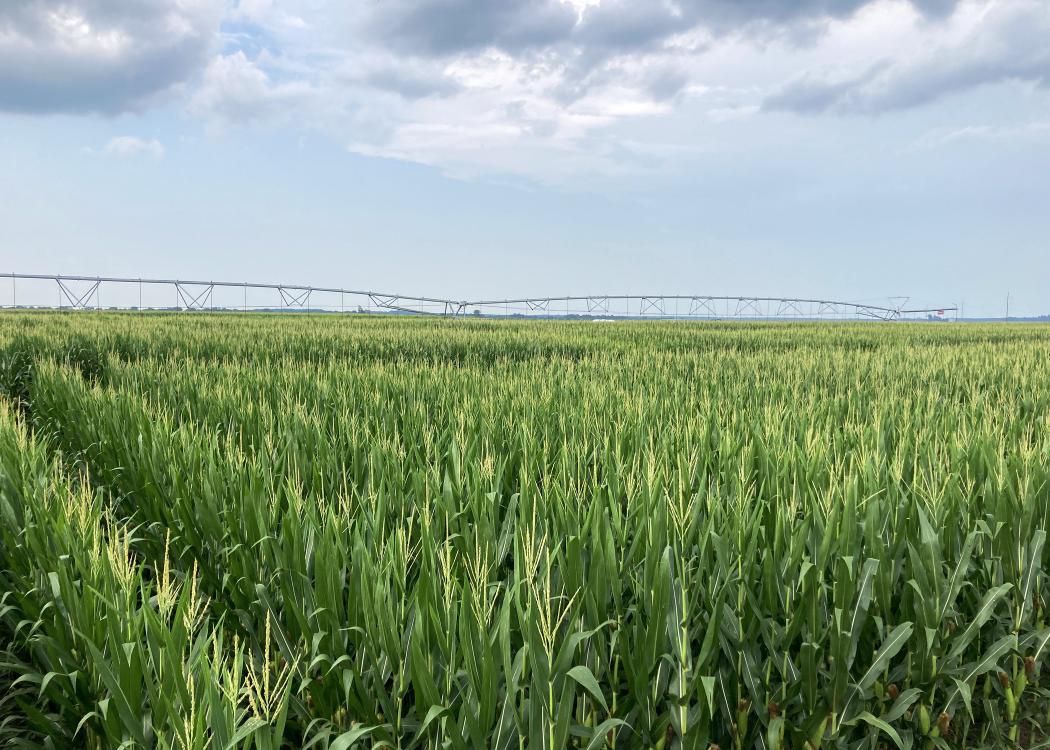
.. Stunted Corn - Many corn fields differ in early plant health due to various fertility, herbicide and insect pest problems. Fertility problems are likely the most common factor limiting early season growth. Many initially believe these problems result from inadequate or poor nitrogen availability, but this is rarely the case. Nitrogen is very mobile in the soil and corn requires relatively little nitrogen until rapid growth begins, so nitrogen fertilizer placement and amount rarely limit early season corn growth. However, soil pH, phosphorus, potassium, magnesium and zinc commonly limit early season corn growth in Mississippi. Field scouting will frequently reveal symptoms indicating a specific problem. However, the best method to diagnose fertility problems is to collect soil and plant tissue samples from stunted and healthy field areas and submit these samples to a reputable soil testing laboratory, such as the MSU Soil Testing Laboratory, for analysis and recommendations. This method is particularly useful for identifying marginal problems, which may not show up when using a composite sampling technique. Purple Corn - Young corn plants appearing stunted with purple lower leaves are likely suffering from phosphorus deficiency. This deficiency is especially prevalent when corn is grown following a rice crop. New leaves emerging from the whorl are usually green, but may turn purple shortly thereafter. Phosphorus deficiency symptoms often occur as young plants are exposed to good growing conditions following cool and wet conditions. This results in a lag phase where vegetative growth exceeds the roots' ability to supply phosphorus. Young plants are especially vulnerable because their root systems are small and phosphorus is immobile in the soil solution. Any cultural or environmental factors which limit root growth will aggravate deficiency symptoms. Examples of such conditions include: cool temperatures, too wet or dry soil, compacted soil, herbicide damage, insect damage, and root pruning by sidedressing knives or cultivators. Acidic soil can also intensify phosphorus deficiency symptoms. Low soil pH severely limits phosphorus availability to plants, which may cause deficiency symptoms even where high soil test phosphorus levels exist. Symptoms normally disappear when favorable growing conditions promote more root growth. However, phosphorus deficiency will likely reduce yield by delaying maturity, decreasing root and stalk development, and reducing energy transfer and storage. Treatment options to quickly remedy phosphorus deficiency have limited effectiveness, since phosphorus is immobile in the soil solution. Surface application of phosphorus fertilizer will limit availability to the top couple inches of soil. Thus, broadcast phosphorus application would be best suited to irrigated fields, where supplemental water would encourage nutrient uptake from shallow depth. Phosphorus injected as a side-dress treatment would increase availability to roots, particularly in dryland fields, however, be careful not to prune roots. Corn root diameter is generally similar to plant height, so don't sidedress much closer to the row than the plant height. When should I start irrigating? Abnormally dry early season conditions have already prompted some growers to start considering irrigation. Drought stress can potentially reduce corn yield anytime during corn's developmental stages. Therefore, irrigation should commence whenever soil moisture becomes limiting. Since corn's water requirement increases with plant size during vegetative stages (from emergence until tassel), plant growth stage does play a determining role, but there is not a definitive growth stage when irrigation should commence. Irrigation initiation is most dependent upon seasonal rainfall and temperatures. Corn's most critical and largest moisture requirement time interval is from tasseling through milk stages.
Sorghum
Establishment and Minimum Stand Sorghum Establishment - Scout sorghum fields diligently during establishment for stand, insect and weed problems. Sorghum seedlings have considerably less vigor than corn which often translates to more difficult stand establishment. Chinch bugs also prefer sorghum compared to corn and since chinch bug populations tend to thrive during warm, dry conditions which have been prevalent thus far this spring, they could cause major sorghum establishment problems. Postemergence herbicide options for sorghum are quite limited, so timely identification and response also is imperative to control weed problems. Scout sorghum fields at least twice a week until sorghum exceeds six inches tall to identify and manage field problems. Minimum Stand - Grain sorghum has tremendous ability to compensate for low stands by producing tillers, especially if plants are spaced uniformly. Thus, the optimum plant population for sorghum is very broad, ranging from 40,000 to 70,000 plants per acre for dryland production. Replanting would be required only if stands were reduced to less than two plants per foot of row or skips exceeding five feet occur in adjacent rows.
CONTACT INFORMATION Dr.
Richard Watson Dr.
Erick Larson Dr. Tim
Walker Dr.
Larry Oldham Dr.
Alan Blaine Jim
Thomas
Dr.
Michael Collins, Department Head |
|||||||||||||||||||||||||||||
|
|
|||||||||||||||||||||||||||||