

By
Norman Winter Few
people recognize the name, Tradescantia, but most people
recognize the specific plant names Wandering
Jew,.Moses-in-the-Cradle, Three-Men-in-the-Boat,
Moses-in-the-Bulrushes, Spiderwort and Purple Heart, which
are all Tradescantia. Every
spring we see the gorgeous blue Spiderwort flowers growing
along our roadsides and in our gardens. While some find the
roadside flower slightly invasive, others say they are
great. Many don't realize that this plant is very closely
related to the Wandering Jew. The
native Spiderworts are known as Tradescantia virginia and
Tradescantia occidentalis. Most have blue flowers, but there
are varieties available with white, purple, rose, red and
even double flowers. The
Wandering Jew name really refers to Tradescantia flumensis
and Tradescantia zebrina. The name zebrina gives a hint that
it does have stripes, but so do some cultivars of the
Tradescantia flumensis. Both are native to Guatemala,
Honduras and Belize. This
summer my wife, Jan, made hanging baskets with some of the
solar coleus growing on top or in the middle, with Wandering
Jew hanging down all around. They have really made a show
all season. The
Moses-in-the-Cradle, Three-Men-in-the-Boat and
Moses-in-the-Bulrushes is known botanically as Tradescantia
spathacea. It gets its name from the flowers clumped in a
purple boat or cradle-shaped bract. These
are really succulent leaves, and the plants are well suited
to hanging baskets, window boxes and anywhere else that it
can be allowed to cascade. These are not very cold hardy and
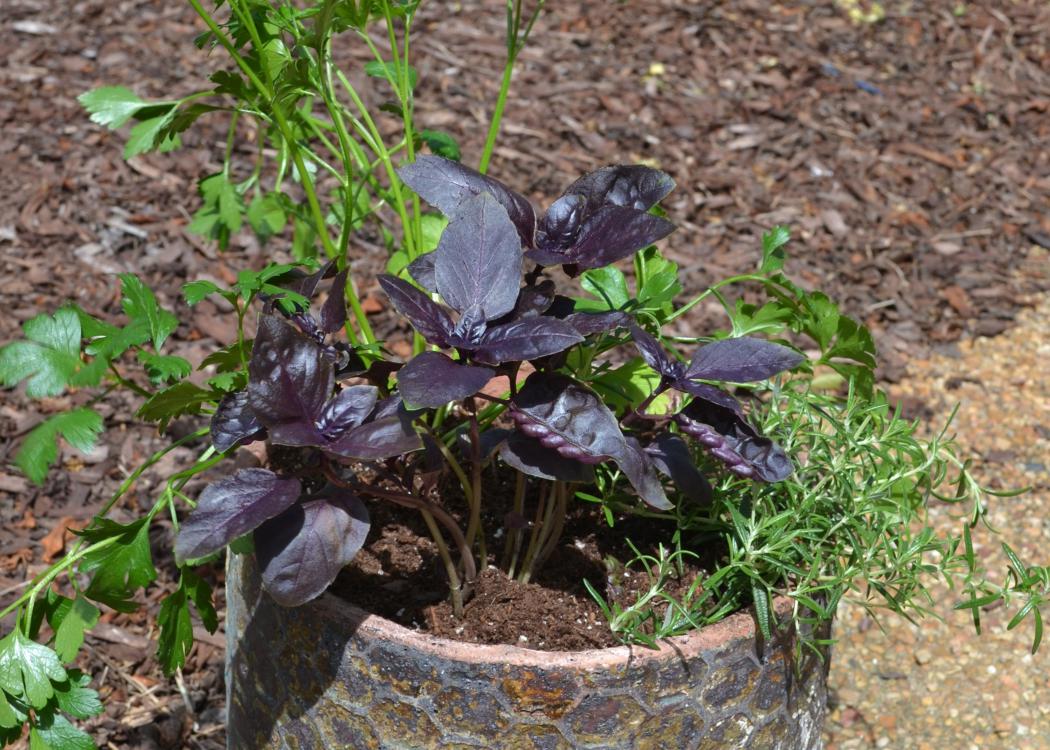
will have to be protected during the winter. Purple
Heart, or Tradescantia pallida, is the one that has all the
landscapers and horticulturists raving. A lot of catalogues,
books and Internet information still refer to it by the name
Setcreasea pallida with the common name
setcreasea. A native
of Eastern Mexico, this deep-purple, vining plant is very
drought tolerant and ideal for landscapes. The color is
outstanding when grown with plants like the New Gold
lantana. The entrance to Northpark Mall in Ridgeland has
some striking plantings with rocks and lantanas. Another
beautiful combination is to plant it with the coral-colored
Salvia coccinea or pink verbenas. Another choice combination
is with ornamental grasses like Fountain or Muhly
grass. The
Purple Heart is perennial in zones 8 and 9 but is still
worth planting in zone 7 as an annual. There are many that
will say that it dies back in zone 7 but returns faithfully
each year with a layer of mulch. Purple Heart prefers a
well-drained, organic-rich bed, but is being touted as the
plant that will grow just about anywhere it doesn't get wet
feet. In fact, root rot is its No. 1 enemy which only occurs
in soggy soils. Since
this is a sprawling type plant, we can increase its
bushiness by pinching or cutting back the terminal ends of
the plant. Purple Heart and Wandering Jew are easy to
propagate by stem cuttings. Just stick one in the soil where
you need a new plant or two, and keep it moist until roots
develop. Then cut back on the water. If you will try Purple
Heart you will get hooked like the rest of us, I
promise. Released:
Sept. 10, 1998 Editor's Note: Ideal publication dates of Southern Gardening columns are within one month of their release. Editors should examine older columns carefully for any information that could be time sensitive.
Southern
Gardening
Spiderwort,
Purple Heart Are Landscape Favorites
Horticulturist
Central Mississippi Research & Extension
Center
Contact: Norman Winter, (601) 857-2284
Visit: DAFVM
|| USDA
Search our Site ||
Need more information about this subject?
Last Modified: Friday, 17-Aug-07 14:43:44
URL: http://msucares.com/news/print/sgnews/sg98/sg980910.htm
Mississippi State University
is an equal opportunity institution.
Recommendations on this web site do not endorse
any commercial products or trade names.