Enthusiastic
gardeners create hummer haven
By
Norman Winter
MSU
Horticulturist
Central Mississippi Research & Extension Center

|
Attract
hummingbirds by planting a garden with a long season
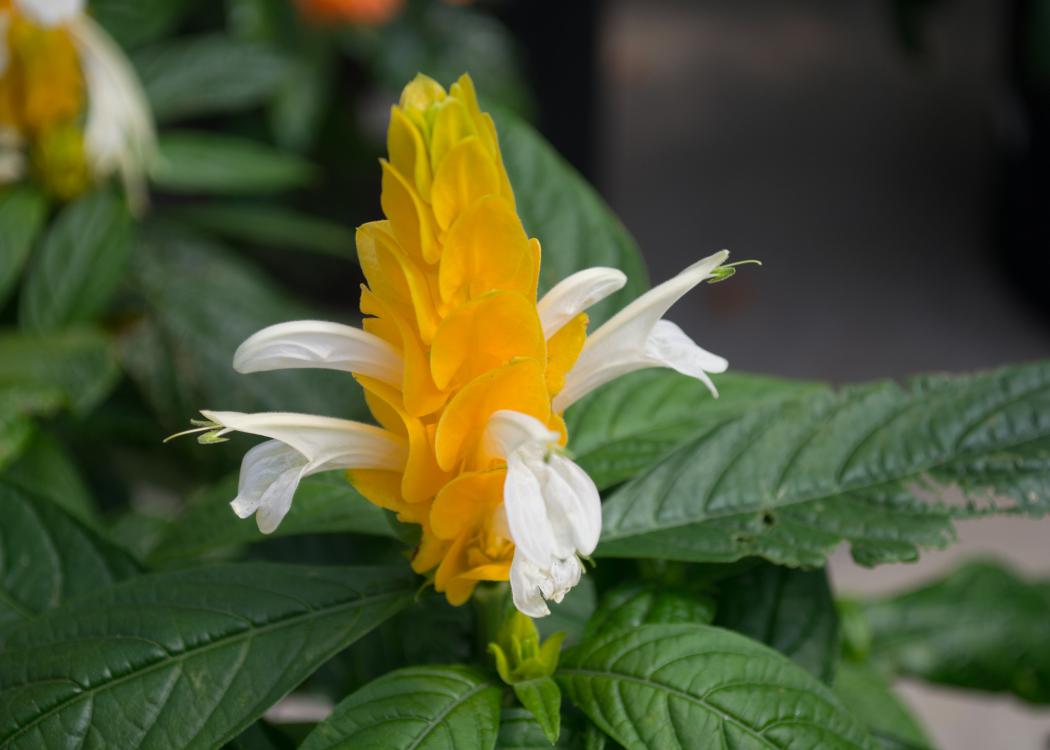
of overlapping bloom. Hummingbirds love to feast
on the nectar of two Mississippi Medallion award
winners, the yellow shrimp plant (Pachystachys lutea)
and Sonset lantana (below). |

|
|
I got a
kick out of the man on late night television recently who
had four hummingbird feeders attached to a hat, trying to
lure the birds in for a little feasting. I kind of feel that
way about these little birds myself.
Natalie
Jordan of Raymond feels the passion, too -- the last time I
checked in, she was using about 5 pounds of sugar a day for
her feeders. But you better believe she also had every plant
a hummingbird loves in glorious bloom.
I
am a lot like Mrs. Jordan, too. As much as a tiger
swallowtail butterfly excites me, I can truthfully say that
hummingbirds do more to get me enthusiastic about gardening.
Notice I said gardening.
Sure,
I like the artificial feeders, but I'm moved when
hummingbirds come to my plants. While I'm cooking rib-eye
steaks on the grill for my family, nearby the hummingbirds
are eating their version in the flower garden.
By
planting a garden with a long season of overlapping bloom,
we can play host to these miniature birds that fly like they
are a cross between a stealth fighter and a helicopter.
Go
ahead and use some artificial feeders, but in the flower
garden, choose plants like the petunia, annual red salvia
(Salvia splendens), blue anise sage (Salvia guaranitica),
and two Mississippi Medallion award winners, the yellow
shrimp plant (Pachystachys lutea) and Sonset lantana. One of
my favorites that is always for sale and often overlooked is
the firebush (Hamelia patens).
Native
plants like the cardinal flower (Lobelia cardinalis); coral
honeysuckle (Lonicera sempervirens), which is not invasive
like the Japanese honeysuckle; trumpet vine (Campsis
radicans) and Indian pink (Spigelia marilandica) are much
loved by hummingbirds. Even in shady flower gardens, we can
attract hummingbirds with hostas and impatiens.
Those
of you who want the best of both worlds -- hummingbirds and
butterflies, that is -- should choose plants like lantana,
butterfly bush and butterfly weed. The same recommendation
for butterfly gardens holds true for hummingbird gardens --
no pesticides!
The
hummingbird can ingest the pesticide, but something many
gardeners aren't aware of is that these little acrobats also
feed on small insects and spiders. It is a bird-eat-bug
world out there.
Besides
their flying technique, hummingbirds are unique creatures
when it comes to eating. When feeding, they lick up to 13
times a second. Like me, they eat every 10 to 15 minutes
from sunrise until sunset and devour more than half their
weight in food.
Then,
believe it or not, they go to bed hungry -- sort of. They
actually have to hibernate through the night, decreasing
their heart rate and body temperature, or they reportedly
would starve to death. This should make you not only want to
grow more flowers, but also take better care of the
artificial feeders.
There
is a lot more to artificial feeders than simply hanging one
in a tree. Nectar from flowers provides more nourishment
than sugar water. To provide a better diet, buy packages of
instant nectar solution or make your own. To make your own,
use 1 part white granulated cane sugar to 4 parts
water.
You
may be thinking, "This is sugar water, right?" But the big
difference is that you need to bring this solution to a boil
for 1 1/2 minutes, and then let it cool down. It is not
necessary to add food coloring. Now you have a mixture much
more similar to that of the flower nectar. Our hot weather
can cause rapid bacterial growth, so change solutions every
three to five days.
One
revelation many of you may find shocking comes from the
Texas Parks and Wildlife department. Many people think they
should take down their feeders in the fall and winter to
encourage the hummingbirds to migrate, but this isn't
true.
Whether
a bird goes or stays is not determined by your feeder.
However, that precious food source might mean life or death
to a straggling hummingbird that braves it through the
winter north of the tropics.
-30-
Released:
June 2, 2005
Contact: Norman
Winter,
(601) 857-2284
Editor's
Note: Ideal publication dates of Southern Gardening columns
are within one month of their release. Editors should
examine older columns carefully for any information that
could be time sensitive.
Publications
may download photograph at 200 dpi: Shrimp
plant
| Sonset
lantana
|